

Affiliate payout safety

Affiliate Payout Safety: How to Check Commission, Holds, and Payment Issues

Affiliate payout safety is not about how big the commission looks.

It is about whether that commission can actually be verified, approved, released, and withdrawn.

For serious affiliates, the better question is: Can you clearly track, verify, and withdraw your earnings without confusion or delay?

This page is not a brand review. It does not accuse any program.

It is a payout-safety and risk evaluation guide for affiliates who need to understand CPA approval, RevShare deductions, hold balances, rejected players, payment cycles, and payout evidence before scaling traffic.

Goal: Do not scale traffic until payout logic is clear and commission is verifiable.

Start Payout Safety Check Trust Check Framework
PAY
SAFE

This page helps you:

  • Check CPA, RevShare, and hybrid payout rules
  • Separate pending, approved, hold, available, and paid balances
  • Review rejected players and payment-cycle risk
  • Build payout evidence before scaling traffic
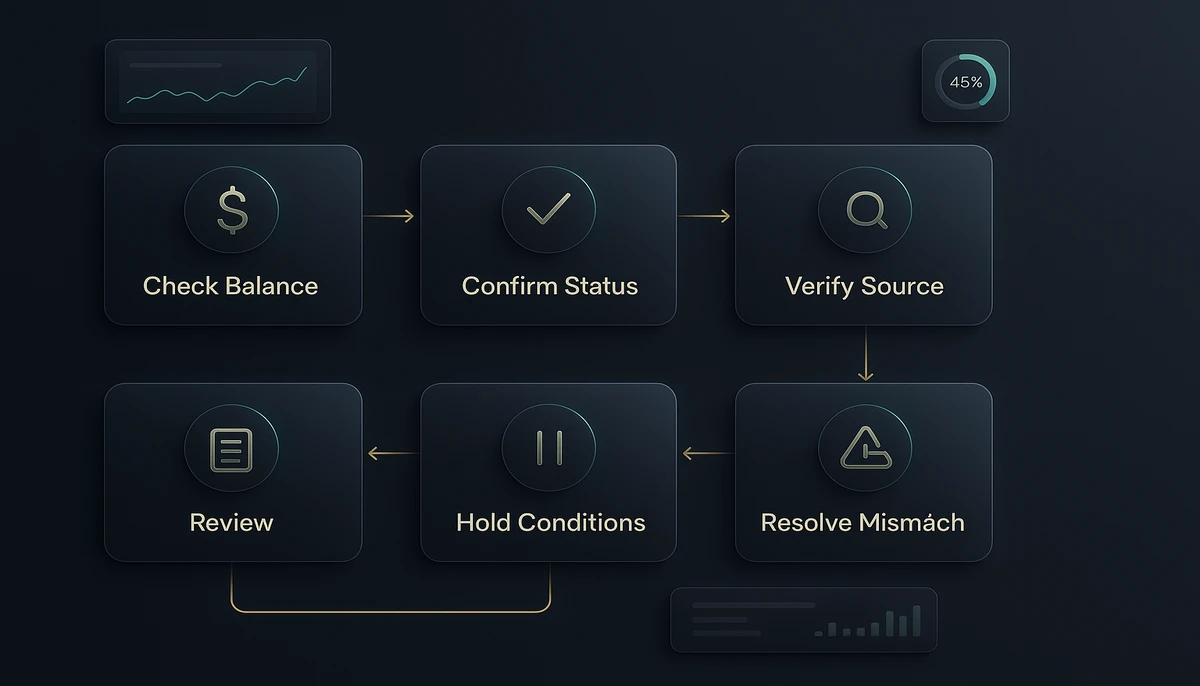
Payout guide purpose

What This Payout Safety Guide Is For

Use this guide before you trust dashboard earnings, request withdrawal, or scale any affiliate program.

Payout safety issues often appear after traffic starts.

Clicks may look strong. Registrations may increase. FTDs may appear.

But if commission status is unclear, scaling becomes risky.

Key payout elements to verify:

  • CPA approval rules
  • RevShare deductions
  • Hybrid payout structure
  • Pending commission
  • Approved commission
  • Hold balance
  • Rejected players
  • Minimum payout
  • Payment cycle
  • Payment method
  • Payout evidence
  • Support escalation

Recommendation: Treat payout verification as part of campaign setup, not after earnings appear.

1

IF payout rules are unclear

THEN do not scale.

2

IF commission is pending only

THEN do not treat it as earned yet.

3

IF hold balance appears

THEN verify release conditions.

4

IF rejected players are unexplained

THEN pause scaling.

5

IF payment cycle is unclear

THEN avoid paid or high-volume traffic.

Action step: Create a payout tracking sheet before running serious traffic.

Scope control

What This Page Does Not Do

This page focuses only on payout safety.

This page does not rank affiliate programs. It does not call any brand unsafe. It does not guarantee payment. It does not replace legal or financial advice. It does not replace brand-level evaluation. It does not compare which program pays the highest.

Use Affiliate Program Trust Check for the full trust framework.

Use Affiliate Program Red Flags for warning signs.

Use Highest Paying Affiliate Programs for payout model comparison.

Recommendation: Separate payout safety from brand opinion.

1

IF you need brand evaluation

THEN read the relevant brand review.

2

IF you need warning signs

THEN use the red flags page.

3

IF you need payout model comparison

THEN use the highest-paying guide.

4

IF you need payout-status control

THEN stay on this page.

Action step: Use this guide as a payout safety checklist before scaling.

Payout matrix

Payout Safety Matrix

Use this matrix before trusting dashboard earnings.

Area Safe Signal Risk Signal
CPA Clear qualification rules “Qualified player” undefined
RevShare Transparent deductions Hidden bonus/admin costs
Hybrid CPA and RevShare both explained One side unclear
Pending Status visible Mixed with approved
Approved Separate approved balance Approval logic unclear
Hold Reason and timeline explained No release explanation
Rejected Clear rejection reasons Hidden rejection logic
Payment Cycle defined Timing vague
Minimum payout Clearly stated Hidden or changing
Method Confirmed payment method Method changes suddenly
Evidence Screenshots, SubIDs, manager notes No record trail

Recommendation: Evaluate payout safety by clarity, not by commission number.

1

IF multiple payout areas are unclear

THEN do not scale.

2

IF payout structure is visible but untested

THEN test small.

3

IF payout becomes predictable after testing

THEN scale gradually.

4

IF payout terms change suddenly

THEN pause and confirm.

Action step: Score each program from 1 to 5 across CPA, RevShare, hold balance, rejection logic, payment cycle, and evidence quality.

CPA safety

CPA Payout Safety

CPA looks simple because it pays a fixed amount per qualified player. The risk is hidden in the word qualified.

CPA can work for paid traffic, Telegram campaigns, fast-conversion funnels, brand-intent traffic, and cricket or sports event traffic.

But CPA is only safe when approval rules are written and measurable.

Recommendation: Never assume CPA equals guaranteed income.

1

IF qualification rules are unclear

THEN do not run paid traffic.

2

IF rejection rate is high

THEN analyze traffic quality by SubID.

3

IF approvals are delayed

THEN separate pending vs approved.

4

IF traffic-source rules are unclear

THEN do not assume Telegram, paid, or social traffic is allowed.

Action step: Request CPA approval rules, rejection rules, and approval timeline in writing before campaign launch.

RevShare safety

RevShare Payout Safety

RevShare depends on how revenue is calculated. The headline percentage is not the real payout.

RevShare can work well for SEO traffic, long-term campaigns, cricket evergreen content, casino and slots content, betting comparison pages, and returning-user audiences.

Risk appears when revenue calculation is unclear, dashboard hides deductions, commission does not match activity, player activity exists but net revenue stays low, or negative carryover affects future periods.

Recommendation: Trust RevShare only when deductions are transparent.

1

IF deductions are unclear

THEN do not rely on headline percentage.

2

IF commission is low compared with player activity

THEN ask for a net revenue breakdown.

3

IF negative carryover applies

THEN evaluate long-term impact.

4

IF casino and sports calculations differ

THEN separate product traffic.

Action step: Ask for a real RevShare calculation example before scaling long-term traffic.

Hybrid safety

Hybrid Payout Safety

Hybrid combines CPA and RevShare. It can support both upfront cash flow and long-term upside, but it can also create confusion.

Hybrid is not automatically safer.

A weak hybrid deal can be worse than choosing CPA or RevShare properly.

Recommendation: Hybrid is safe only when both payout components are clear.

1

IF CPA rules are unclear

THEN the hybrid deal is incomplete.

2

IF RevShare deductions are unclear

THEN the hybrid deal is incomplete.

3

IF the dashboard cannot separate CPA and RevShare

THEN reconciliation risk increases.

4

IF both sides are reduced heavily

THEN compare against single-model alternatives.

Action step: Compare hybrid against pure CPA and pure RevShare before choosing.

Commission status

Commission Status: Pending, Approved, Hold, Available, and Paid

Affiliate dashboards often show several balance types. Do not confuse them.

Key rules:

  • Pending does not mean earned.
  • Hold does not mean withdrawable.
  • Approved does not always mean paid.
  • Available is usually closer to withdrawable, but still confirm minimum payout and payment method.
  • Paid should match actual received payment records.

Before trusting any balance, ask:

  • Is this amount available for withdrawal?
  • What conversions are included in the hold balance?
  • Which conversions are still pending verification?
  • Which conversions are already approved?
  • What is the release schedule?
  • Are documents or extra checks required?
  • Can support provide a breakdown by date, player status, and commission amount?
  • Does the hold balance include CPA, RevShare, referral, or mixed earnings?
  • Is there a minimum payout threshold before withdrawal?
  • What payment cycle applies?

Recommendation: Separate visible balance from withdrawable balance.

1

IF balance is pending

THEN wait for approval before treating it as earned.

2

IF balance is on hold

THEN ask for reason, release conditions, and timeline.

3

IF balance is approved

THEN verify payment method and minimum payout.

4

IF balance is available

THEN confirm withdrawal rules.

5

IF support cannot explain balance status

THEN do not scale.

Action step: Track balance status weekly and save screenshots before and after each payout cycle.

Hold balance

Hold Balance and Release Timeline

Hold balance is one of the most misunderstood payout areas.

A hold balance is not always bad.

But it becomes risky when the program cannot explain why the money is held or when it may be released.

Recommendation: Treat hold balance as “not yet withdrawable” until release conditions are confirmed.

1

IF hold amount increases but approved balance does not

THEN ask for a conversion breakdown.

2

IF hold release date is unclear

THEN pause scaling until support explains.

3

IF hold balance includes rejected or unqualified users

THEN separate them from approved value.

4

IF documents are required

THEN prepare them before payout deadline.

Action step: Ask support for hold balance breakdown by conversion date, player status, traffic source, and commission amount.

Rejected players

Rejected Players Risk

Rejected players reduce real earnings. This does not automatically mean a program is unfair, but rejection logic must be explainable.

Rejected players should be reviewed by source, geo, and SubID.

A high rejection rate from one Telegram channel is a different problem from mixed rejection across every source.

If the dashboard cannot show rejection reasons, you cannot optimize traffic quality properly.

Recommendation: Treat rejection as a traffic-quality and payout-safety signal.

1

IF rejection reasons are explained

THEN optimize traffic quality.

2

IF rejection reasons are hidden

THEN pause scaling.

3

IF one source causes most rejections

THEN isolate or stop that source.

4

IF all sources show rejection

THEN review geo, offer, verification, and traffic-source rules.

Action step: Track rejected players by SubID, source, geo, campaign, and rejection reason.

Payment cycle

Minimum Payout and Payment Cycle

Payment cycle matters because traffic cost and payout timing may not match.

For paid traffic, payout timing can create cash-flow pressure.

For SEO traffic, it affects how quickly you can validate real revenue.

For Telegram traffic, it affects how safely you can scale after a spike.

Recommendation: Match payout cycle with your cash-flow needs.

1

IF cycle is unclear

THEN do not scale.

2

IF minimum payout is too high

THEN test whether your traffic can realistically reach it.

3

IF payment method is unclear

THEN verify early.

4

IF payout requires documents

THEN prepare them before requesting withdrawal.

Action step: Add minimum payout, payment cycle, method, and document requirements to your affiliate sheet.

Dashboard proof

Dashboard Evidence for Payout Safety

The dashboard is your proof layer.

Weak dashboard evidence creates weak payout confidence.

If the dashboard cannot separate pending and approved commission, payout status becomes unclear.

If it cannot show SubIDs, source-level dispute evidence becomes weaker.

If it cannot show rejected players, CPA risk becomes harder to manage.

Recommendation: Do not scale traffic when payout evidence is weak.

1

IF data is missing

THEN do not scale.

2

IF pending and approved are mixed

THEN ask for clarification.

3

IF rejected players are hidden

THEN CPA risk increases.

4

IF dashboard data conflicts with your own logs

THEN pause scaling.

5

IF reporting is clear and stable

THEN continue controlled testing.

Action step: Screenshot dashboard data weekly, before payout requests, and after payout updates.

Dispute evidence

Payout Dispute Evidence

If payout does not match your expectation, evidence matters.

Do not escalate emotionally.

Escalate with evidence.

A clear support message might include:

  • Campaign date range
  • Traffic source
  • SubID
  • Click count
  • Registration count
  • FTD count
  • Pending amount
  • Approved amount
  • Hold amount
  • Rejected players
  • Screenshot references
  • Question you want answered

Recommendation: Evidence wins payout disputes.

1

IF you have proof

THEN resolution becomes easier.

2

IF you have no SubIDs

THEN dispute quality is weaker.

3

IF manager messages conflict with dashboard data

THEN ask for written clarification.

4

IF mismatch remains unresolved

THEN pause scaling until explained.

Action step: Create one payout evidence folder per affiliate program.

Controlled test

7–14 Day Payout Safety Test

Run a controlled payout safety test before serious scaling.

Do not test payout safety with mixed traffic.

If SEO, Telegram, paid, casino, cricket, and sports traffic are mixed, the payout signal becomes hard to explain.

Recommendation: Test before scaling.

1

IF data is clean

THEN scale gradually.

2

IF payout status is unclear

THEN stop or stay low-volume.

3

IF approval is delayed

THEN wait for the full cycle.

4

IF rejected players are unexplained

THEN do not scale.

5

IF support answers clearly

THEN the program becomes more testable.

Action step: Run a payout safety test before placing a program in primary recommendation slots.

Final checklist

Payout Safety Checklist

Before scaling, answer these payout-safety questions.

Withdrawal readiness

Payment and evidence questions

  • Can I see hold balance?
  • Do I know what hold means?
  • Can I see rejected players?
  • Are rejection reasons explained?
  • Do I know minimum payout?
  • Do I know payment cycle?
  • Do I know payment method?
  • Is support responsive?
  • Have I tested?
  • Do I have evidence?

Recommendation: Do not scale without payout clarity.

1

IF five or more answers are unclear

THEN remain in test mode.

2

IF payout rules and dashboard evidence are clear

THEN consider controlled scaling.

3

IF approved commission appears but payment method is unclear

THEN resolve payment setup first.

4

IF payout issues repeat

THEN reduce exposure.

Action step: Copy this checklist into your affiliate operations sheet.

FAQ

FAQ

Affiliate payout safety is the ability to verify, track, approve, release, and withdraw affiliate commission clearly.

It means you understand how money moves from click to registration, FTD, pending commission, approved commission, hold balance, and final withdrawal.

Decision: IF you cannot explain how commission becomes withdrawable, THEN payout safety is weak.

Hold balance is commission that appears in the dashboard but is not yet available for withdrawal.

It may be waiting for player verification, activity review, fraud checks, payment cycle processing, manager approval, or traffic-source validation.

Decision: IF hold balance appears, THEN ask support for reason, release timeline, and conversion breakdown.

No. A high CPA or RevShare percentage is only useful when qualification rules, deductions, rejection logic, payment cycle, and withdrawal conditions are clear.

A program can show a strong headline number but still produce weak real payout if many conversions remain pending, rejected, or held.

Decision: IF the commission looks high but payout rules are vague, THEN do not scale traffic yet.

Pending commission is still under review.

Approved commission has usually passed the program’s rules, but it may still need to meet withdrawal requirements such as minimum payout, payment cycle, or document checks.

Decision: IF commission is pending, THEN do not treat it as withdrawable yet.

Players may be rejected because of duplicate accounts, invalid geo, failed verification, fraud flags, bonus abuse, restricted traffic source, unqualified deposits, or minimum activity rules.

Decision: IF rejected players are not explained, THEN pause scaling until support clarifies the reason.

CPA is simpler only when qualification rules are clear.

RevShare can have long-term value, but only when deductions and net revenue calculation are transparent.

Neither model is automatically safe.

Decision: IF CPA approval rules or RevShare deductions are unclear, THEN both models carry payout risk.

No.

Paid traffic creates cost before payout is approved.

You need CPA rules, traffic-source approval, rejection logic, payment cycle, and minimum payout terms in writing before spending.

Decision: IF payout rules are not written, THEN do not run paid traffic.

Check payment cycle, minimum payout, hold status, approved balance, payment method, required documents, and support messages.

Then contact support with screenshots, SubIDs, campaign dates, and payout status.

Decision: IF payout delay cannot be explained, THEN pause scaling until the issue is clear.

Use written payout terms, clean SubIDs, traffic-source separation, screenshots, dashboard logs, and manager messages.

The clearer your evidence, the easier it is to investigate payout issues.

Decision: IF you cannot prove where traffic came from, THEN payout disputes become harder.

Final CTA

Do not trust commission just because it appears in your dashboard.

Verify it.

Check CPA rules. Check RevShare deductions. Check hybrid terms. Check hold balances. Check rejected players. Check payment cycles. Keep evidence.

Scale only when payout is predictable.

Leave a Reply

Your email address will not be published. Required fields are marked *