
Analyzing how weather affects cricket matches: the atmospheric physics guide is the absolute corner-stone of sports analytics, pitch preparation engineering, and captaincy tactics because cricket is fundamentally more dependent on atmospheric variations than any other major global sport. In sports like football or basketball, environmental shifts might alter player comfort or ball slipperiness, but the underlying core mechanics of the game remain static. In cricket, alternating atmospheric pressures, real-time relative humidity drops, and localized solar radiation levels completely dictate how a leather ball swings through the air, how a compacted clay pitch breaks apart, and how team resources are mathematically re-calculated during sudden rain delays.
As the international sports science landscape hits unprecedented heights in 2026, relying on generic intuition about the weather is obsolete. Modern teams utilize localized meteorological telemetry and soil-moisture sensors to transform weather monitoring into a precise, predictive competitive advantage.
In this comprehensive, data-backed guide, we will dissect the precise fluid dynamics governing aerodynamics in cricket, break down how different climates alter pitch behaviors across match days, and deliver an operational checklist to navigate official weather-disruption laws with absolute clarity.
1. Aerodynamic Fluid Dynamics: The Science of Swing
The most direct and immediate manifestation of how weather affects cricket matches: the atmospheric physics guide is observed in the aerodynamic behavior of the cricket ball through the air—specifically the phenomenon of “swing bowling.”
The Relative Humidity and Air Density Myth
A historical error perpetuated in legacy articles is the claim that “heavy, damp air pushes a cricket ball to swing more.” From a physics standpoint, this is completely inaccurate. Humid air is actually less dense than dry air because water molecules ($\text{H}_2\text{O}$) are lighter than nitrogen ($\text{N}_2$) and oxygen ($\text{O}_2$) molecules. Therefore, a ball traveling through highly humid air experiences less aerodynamic drag, not more.
Overcast Clouds and Boundary Layer Stability
The true correlation between overcast weather and lethal ball swing relies on solar radiation and localized wind turbulence:
-
On Clear, Sunny Days: The sun aggressively heats the grass and soil surface. This causes warm air to rapidly rise off the pitch, creating chaotic thermal updrafts and microscopic convective turbulence. This turbulent air immediately breaks up the smooth, laminar airflow tracking along the side of a shiny cricket ball, suppressing late swing movement.
-
On Overcast, Cloudy Days: The cloud cover acts as a massive thermal shield, blocking direct solar heating. The air blanket sitting directly above the grass pitch surface stays perfectly stable and cool. Without chaotic thermal updrafts, the airflow tracking over the scuffed and shiny sides of the ball remains undisturbed (laminar boundary layer flow), allowing the pressure differentials to generate severe, late, and unpredictable swing lines that terrorize top-order batsmen.
2. Solar Desiccation and Pitch Degradation Timelines
While the atmosphere controls the ball through the air, solar radiation and ground heat entirely manipulate the behavior of the ball off the pitch surface.
The Baking Effect on Natural Clay
A professional cricket pitch (the wicket) is built out of specialized clay soils rolled into high-density sheets under immense mechanical pressure. The lifecycle of this surface is entirely dependent on solar desiccation (drying):
-
High Intense Sunshine: Continuous solar heating rapidly evaporates the inner moisture binding the clay particles together. As the moisture leaves, the pitch surface contracts, hardens, and cracks. During the early days of a match, this high surface hardness delivers true, consistent bounce and high velocity, allowing batsmen to time their runs perfectly. However, by days 4 and 5 of a Test match, the extreme heat crumbles the edges of the cracks, turning the wicket into an abrasive, uneven minefield where spin bowlers extract sharp, vicious, and unpredictable turn.
-
Overcast and Cool Climates: When a pitch is starved of direct sunlight, it retains its core moisture levels for a prolonged window. This internal dampness softens the clay matrix, functioning as a shock absorber when a ball strikes the ground. The resulting bounce becomes slow, spongy, and low, forcing batsmen to play off the front foot and heavily penalizing high-velocity express fast bowlers.
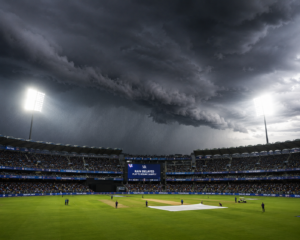
3. The Regulatory Math: Navigating Rain Disruption Laws
Weather does not just influence sports equipment mechanics; it actively rewritten the competitive laws of the match through the deployment of official mathematical modeling.
The DLS Method (Duckworth-Lewis-Stern Model)
Because cricket is highly susceptible to precipitation, sudden rain delays during limited-overs matches (ODIs and T20s) create an immense administrative challenge: how do you fair adjust a target score when one team has their innings cut short? Modern cricket completely abandons crude, unscientific average run-rate calculations, deploying the advanced Duckworth-Lewis-Stern (DLS) Method.
The DLS model treats a team’s innings as an exercise in financial asset management, declaring that every side possesses two primary “resources” to score runs: Overs Remaining and Wickets Lost.
-
If rain strikes in the 10th over of a T20 match while a team is 80/1, they have only consumed a fraction of their resources. The DLS software calculates their remaining resource percentage against historical databases, dynamically increasing or lowering the secondary team’s target score to a precise decimal value.
-
If a team loses quick, consecutive wickets right before a predicted rain cloud arrives, their resource capital collapses, resulting in a heavily inflated DLS adjusted target that penalizes their poor tactical asset management.
Analytical Matrix of Environmental Climates
To provide your readers with a clear, scannable overview of how specific meteorological configurations alter match dynamics in real-time, review the audited environmental matrix below:
| Meteorological Profile | Immediate Aerodynamic Impact | Real-time Pitch Surface Response | Primary Tactical Advantage | Optimal Team Roster Strategy |
| Hot, Dry Sunshine | High thermal updrafts; zero late ball swing. | Accelerates desiccation; opens structural cracks. | Favors top-order batsmen early; spin bowlers late. | Deploy dual spin bowlers; win toss and bat first. |
| Heavy Overcast / High Humidity | Stable, cool boundary layer; prolonged ball swing. | Retains deep clay moisture; creates spongy bounce. | Heavy advantage to high-velocity seamers. | Deploy swing specialists; bowl first to exploit movement. |
| Sudden Cold Precipitation (Rain) | Heavy dampness scuffs the leather seam rapidly. | Slick surface layer; introduces dangerous slipping risks. | Forces immediate DLS mathematical target calculation. | Keep wickets intact ahead of cloud arrivals to preserve DLS. |
| High Dynamic Wind Speeds | Alters ball flight path depending on crosswind vector. | Dries out the outfield turf at accelerated rates. | Assists high-loft power-hitters hitting downwind. | Field captains must adjust boundary depth downwind. |
Step-by-Step Analytical Protocol to Track Weather Variables
To evaluate a professional international fixture like a seasoned sports meteorologist and anticipate major tactical adjustments before they happen on screen, implement this structured tracking protocol:
Step 1: Monitor the Dew Point and Night Temperature Divergences
In day-night matches hosted across regions like India, Australia, or the UAE, “The Dew Factor” is a massive environmental variable. As the sun sets, the ground temperature falls below the atmospheric dew point, causing heavy moisture to condense directly onto the grass blades. The Impact: The cricket ball becomes completely soaked, smooth, and slippery. Spin bowlers lose the physical friction needed to grip the leather seam, and fielders struggle to execute clean throws, giving a massive structural advantage to the team batting second in the evening.
Step 2: Audit Local Soil-Clay Origin Profiles
Different venues react uniquely to the exact same weather conditions depending on their foundational clay engineering:
-
Black Soil Wickets (e.g., Mumbai, Brisbane): Features high elasticity and deep clay concentration. They hold their structure exceptionally well against heat, producing consistent bounce across multiple days.
-
Red Soil Wickets (e.g., Chennai, Colombo): Features low cohesion and high iron-oxide degradation. They dry out rapidly under sunshine, fracturing into loose dust within hours and assisting slow turn bowlers almost immediately.
Step 3: Stream from Certified Digital Platforms Safely
When tracking real-time meteorological radar updates and live match pitch diagnostics, avoid accessing unverified streaming links or sketchy live scoreboards. These free mirrors are notorious vectors for invasive tracker cookies and malware scripts. Secure your data stream entirely by anchoring your media dashboard to official digital partners (such as Willow TV, Sky Sports, or Fox Cricket) to experience clean, uncompressed Ultra-HD 4K analysis safely.
Responsible Engagement and Personal Time Boundaries
Immersing yourself in the complex, data-driven world of sports engineering and climate-tactical modeling demands strong personal discipline, emotional maturity, and clear personal boundaries.
Crucial Safeguards for Professional Fans:
-
Isolate Weather Data from Emotional Fandom: Never let personal allegiance to a specific national roster cloud your objective, scientific evaluation of pitch dampness, changing cloud cover, and DLS resource statistics.
-
Enforce Strict Temporal Constraints: Because rain delays can extend cricket match broadcasts by multiple hours into unpredictable night zones, set hard personal alert limits to prevent viewing from overriding your sleep cycles, academic duties, or occupational responsibilities.
-
Respect the Umpire Safety Thresholds: Avoid growing frustrated during prolonged ground inspections after a rain storm. Professional match officials halt play based on rigid safety data—if the compacted clay surrounding the bowler’s landing crease is too soft or damp, executing a high-velocity delivery will cause catastrophic knee or ankle ligament ruptures. Player health must always supersede entertainment values.
Final Verdict
Mastering your strategic understanding of how weather affects cricket matches: the atmospheric physics guide is a matter of choosing unyielding fluid aerodynamic data, precise soil desiccation tracking, and DLS resource mathematics over generic pre-match commentary clichés. By recognizing that overcast conditions protect smooth boundary layers to create late ball swing, while direct solar radiation breaks down clay structures to unlock mystery spin, you take complete control of your sports analytics portfolio. Treat your environmental monitoring with precise scientific logic, manage your media time allocation with absolute discipline, and enjoy the premier tactical satisfaction of predicting pitch evolutions like a true sporting insider.
Disclaimer: Cricket regulatory codes, DLS software algorithms, and ground safety measurements undergo periodic refinement by individual domestic boards and the ICC. This technical meteorological analysis is compiled strictly for educational, historical, and sporting informational purposes. Following live outdoor sporting events always involves an inherent variance of real-world environmental results. Viewers are legally responsible for verifying local regional media broadcasting compliance, practicing responsible time allocation, and maintaining healthy personal entertainment boundaries at all times.
