
Exploring the fascinating history of cricket is like taking a journey through centuries of cultural evolution, geopolitical shifts, and the transformation of a simple rural pastime into a multi-billion-dollar international phenomenon. Today, cricket stands proudly as the world’s second most popular sport, boasting an estimated fanbase of over 2.5 billion people. While modern viewers are familiar with the high-octane drama of stadium floodlights and rapid T20 franchise leagues, the roots of this elegant game stretch back to the quiet, sheep-grazed pastures of medieval England.
To truly appreciate the strategic depth of modern cricket, one must understand how the sport survived royal bans, adapted to the industrial revolution, and spread across the globe through the expansion of the British Empire.
In this comprehensive guide, we will trace the complete evolutionary timeline of cricket, analyze the historical shifts in equipment and regulations, and provide a flawless historical blueprint to understand how this timeless game captured the hearts of nations worldwide.
1. The Humble Origins: Medieval Shepherds to Rural Pastime
The exact decade of cricket’s birth remains a subject of intense debate among sports historians. However, the consensus baseline reveals that the history of cricket officially began as a children’s game in the south-east of England during the late middle ages—specifically around the 13th or 14th century.
The Original Equipment
In its earliest form, cricket was played by young shepherds in the radial downs of Kent and Sussex.
-
The Ball: Originally a simple compact ball of sheep’s wool or rags.
-
The Bat: Not the beautifully engineered willow blades we see today, but rather an ordinary wooden shepherd’s crook, a tree branch, or a paddle-shaped farm tool.
-
The Wicket: Farmers used the natural environment as targets, most notably the heavy wooden gates of sheep pens (known as a “wicket”) or a simple tree stump.
The first definitive, legally documented reference to adults playing cricket occurred in the year 1597, where a court case in Guildford mentioned a game of “creckett” being played on common land. By the 17th century, the game had successfully broken out of its childhood shell, with grown men organizing competitive village matches across the English countryside.
2. The 18th Century: Aristocratic Patronage and the First Rules
The 18th century was the defining era that transformed cricket from a chaotic village game into a highly structured, prestigious sport. This massive shift was driven entirely by wealthy English aristocrats and noblemen who discovered a passion for the game—primarily due to its high potential for sports wagering and gambling.
The Birth of Famous Clubs and Hambledon
To secure their gambling investments, these rich patrons began recruiting the finest rural players, effectively creating the world’s first professional cricketers. In the 1760s, the famous Hambledon Club was founded in Hampshire. For decades, Hambledon acted as the absolute cradle of cricket, developing elite playing techniques and standardizing early equipment profiles.
Evolution of the Equipment and Rules
It was during this period that the sport underwent massive mechanical changes:
-
The Evolution of the Bat: Originally, bowlers bowled the ball underarm along the ground, causing bats to be shaped like hockey sticks to scoop the ball upward. As bowlers began pitching the ball through the air, the bat profile was forced to evolve into a straight, vertical wooden blade.
-
The Creation of the MCC: In 1787, the Marylebone Cricket Club (MCC) was officially formed in London. The MCC immediately took absolute ownership of the “Laws of Cricket,” establishing standard weights for the leather ball, the dimensions of the pitch (22 yards), and introducing the legendary third stump to create the modern wicket system.
3. The Imperial Expansion: How Cricket Went Global
As the British Empire expanded its global footprint throughout the 18th and 19th centuries, military regiments, merchants, and colonial administrators carried their favorite summer sport with them to every foreign outpost. This imperial migration is the direct reason why cricket is deeply rooted in the cultural DNA of nations thousands of miles away from London.
The Subcontinent and the Caribbean
-
India and Pakistan: British sailors introduced cricket to India as early as 1721. The Parsi community in Mumbai was the first local population to enthusiastically adopt the sport, laying the groundwork for what would eventually become the world’s most passionate cricket ecosystem.
-
The West Indies: Plantation owners introduced the game to the Caribbean islands. Over generations, local Afro-Caribbean players completely revolutionized the sport by injecting a distinct style of explosive athletic power and psychological flair into the traditional English framework.
The First International Sports Event
Many people assume that the world’s first international sporting fixture belonged to football or the Olympic Games. In reality, that honor belongs to cricket. In 1844, a historic international cricket match was contested in New York City between the United States and Canada, attracting over 10,000 spectators and establishing cricket as a global pioneer of international sports diplomacy.
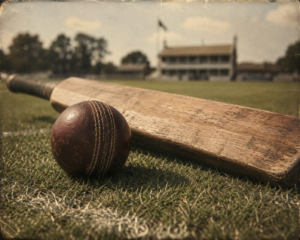
4. The Golden Age and the Birth of Test Cricket
The late 19th century is universally celebrated by sports historians as the “Golden Age” of cricket. The invention of the steam locomotive allowed teams to travel easily across counties and nations, paving the way for elite touring squads.
The Ashes and W.G. Grace
In 1877, the first official Test Match in the history of cricket took place between England and Australia in Melbourne. This intense rivalry birthed “The Ashes” in 1882—a legendary trophy container symbolizing the cremated ashes of English cricket after Australia defeated them on English soil for the first time.
This era was dominated by Dr. W.G. Grace, an iconic figure with a massive beard who completely revolutionized modern batting mechanics. Grace taught the world how to play shots off both the front and back foot, effectively shifting cricket from a primitive physical slog into a beautiful, highly calculated art form.
5. The Modern Era: Limited Overs and the T20 Revolution
For nearly a century, cricket remained a traditional, slow-burning game played over three to five consecutive days. However, as the 20th century progressed, the fast-paced demands of television broadcasts and modern working-class life forced the sport to innovate dramatically.
The Rise of ODI Cricket (1970s)
In 1971, the One Day International (ODI) format was born, capping matches at 50 overs per team and ensuring a definitive winner emerged within a single day. This led to the creation of the first-ever ICC Cricket World Cup in 1975, turning the game into a spectacular global tournament. The late 1970s also saw the “World Series Cricket” revolution introduced by Kerry Packer, which debuted colored clothing, white cricket balls, and dramatic night matches played under massive stadium floodlights.
The T20 Franchise Explosion (2000s – Present)
The ultimate structural shift in the history of cricket arrived in 2003 with the introduction of Twenty20 (T20) cricket. By shortening the entire match length to a tight, explosive three-hour window, cricket successfully adapted to the entertainment consumption habits of the 21st-century audience.
The launch of the Indian Premier League (IPL) in 2008 completely commercialized the sport, transforming cricket players into global multi-million-dollar icons, driving massive digital media traffic, and cementing the game as a financial juggernaut of modern sports entertainment.
Summary Checklist of Cricket’s Evolutionary Timeline
To keep this vast historical narrative perfectly scannable and organized for your readers, here is the official chronological blueprint of cricket’s evolution:
| Time Period | Major Evolutionary Milestone | Structural Impact on the Sport |
| 13th – 16th Century | Origins in Rural England | Born as a children’s farm game using sheep pens and crooked sticks. |
| 18th Century (1787) | Formation of the MCC | Standardization of the official Laws of Cricket and the 3-stump wicket. |
| 1844 | First International Match | USA vs. Canada in NYC; the birth of international sports touring. |
| 1877 | Birth of Test Cricket | First official England vs. Australia match; launching legendary historic rivalries. |
| 1971 | One Day Internationals (ODI) | Introduction of single-day, 50-over games and commercial TV broadcasts. |
| 2003 – Present | The T20 Franchise Era | Explosive 3-hour formats and global commercial leagues like the IPL. |
Final Verdict
Reflecting on the profound history of cricket proves that the game’s true brilliance lies in its unique capacity to adapt without losing its traditional core soul. From the ancient, uneven pastures of English medieval farms to the thunderous, high-tech stadium atmospheres of modern Mumbai and Melbourne, cricket has seamlessly remolded itself across every century.
By understanding the historical path of the sport—how it transitioned from an underarm village game into a sophisticated multi-day tactical chess match, and finally into a fast-paced modern entertainment product—you gain a much deeper appreciation for every boundary hit and wicket taken on the pitch today. Cricket is not just a game; it is a living historical monument that continues to evolve, unite cultures, and break global boundaries with every single over bowled.
Disclaimer: Historical records, match timelines, and early sporting statistics are gathered and authenticated via archival documents maintained by the Marylebone Cricket Club (MCC) Museum and the International Cricket Council (ICC). While this comprehensive guide provides an optimized overview of the sport’s global evolution, minor regional rule variations or alternative historical theories may exist across different historical sporting institutions.
